Creasy
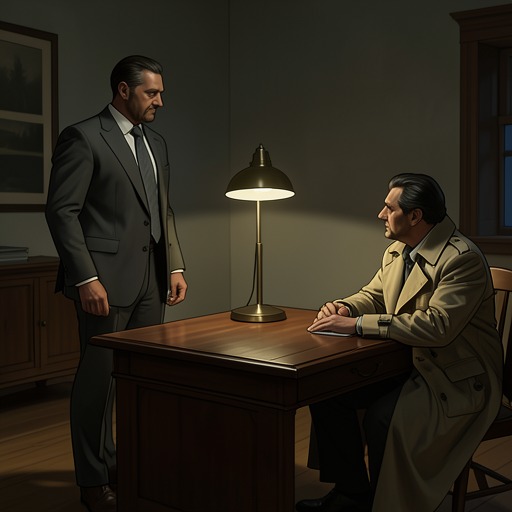
Man on FireCreasy is an American veteran whose life is shaped by childhood poverty, military service, and a hard-won capacity for attachment. The novel first presents him through Guido Arrellio’s watchful recognition: summoned to the Pensione Splendide at dawn, Guido sees that five years have changed his old comrade and notices the empty bottle beside him. The image introduces a man whose discipline and formidable experience coexist with visible decline.
Identity and Background
Creasy’s isolation has roots in a childhood marked by deprivation and loss. His mother died of pneumonia when the family had no money for adequate medical attention; his father died the following year, his passing eased by alcohol. At fourteen, Creasy was taken in by neighbors, who put him to work in the fields for the lowest cost. He ran away at sixteen and joined the Marines a year later. The sequence offers no gradual passage into security: orphaned, exploited, and on his own, he moves from precarious labor into military life.
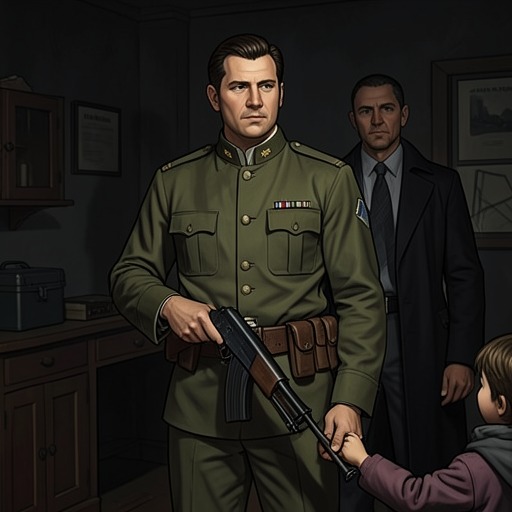
His later service in the French Foreign Legion brings him into contact with Guido. Creasy, an American and a decorated veteran of Vietnam, had recently returned to active service after nine months in a Viet Minh prisoner-of-war camp; he was captured at Dien Bien Phu. He served as a top sergeant in B Company of the 1st R.E.P., the elite First Paratroop Regiment stationed at Zeralda, as the Algerian War escalated. Guido, the only Italian in his intake, had volunteered for the regiment after training. The two men initially occupied different positions: Guido was an untried legionnaire, while Creasy was an experienced noncommissioned officer.
Their recognition of one another developed slowly. Both were taciturn, introspective, intensely private men who shunned ordinary social contact, and the Legion offered little privacy in which to retreat. Several months passed before they understood the empathy between them. Their first conversation beyond Creasy’s orders came after an action near Palestro, where the 1st R.E.P. pursued the Algerian National Liberation Front following an ambush that killed many French conscripts. B Company was dropped to block the insurgents’ escape route. Guido, confused at first by the noise and movement of his first action, settled quickly and used his light machine gun effectively; the Algerian National Liberation Front unit was wiped out. Against that violent setting, Creasy’s first personal approach to Guido marks the beginning of a connection built less through disclosure than through shared reserve and experience.
The Bodyguard's Post
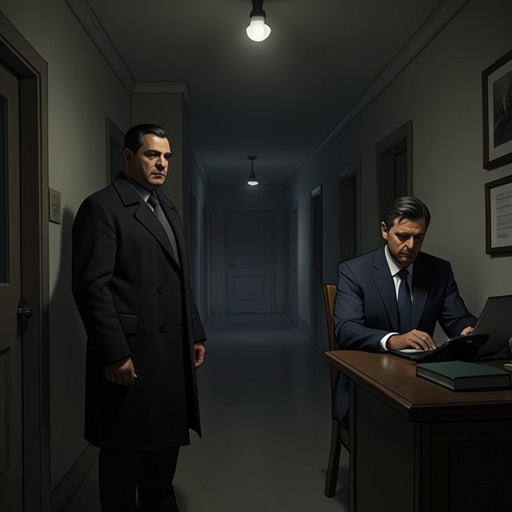
When Guido proposed a bodyguard's post, Creasy initially met the suggestion blankly. The role came through Elio's recommendation, and it brought him into the Balletto household, where the work was unlike anything he had done before. Yet the habits he had acquired in earlier jobs immediately reasserted themselves. After dinner he cleaned his gun with practiced, almost automatic movements, while mentally cataloguing the people around him and considering how each might affect him and the assignment. The weapon and the assessment of the household belonged to the same routine: a new kind of employment was still something to be approached through discipline and appraisal.
That appraisal began with Ettore Balletto and the business behind the family name. Balletto Mills, Creasy learned, was among the largest producers of knitted silk fabric in Italy and in the world. Ettore had inherited the enterprise from a father respected in Milan's business community, and was himself regarded as a good businessman; like other Italian textile producers, however, he faced fierce competition from the Far East. Creasy read Ettore's preoccupation as probably connected to business, a practical judgment rather than an intimate one. He also noted that Ettore was known for the beauty of his wife, Rika.
Creasy's attention to Rika was more exacting, though he considered her dispassionately. He admired the absence of conspicuous adornment: little makeup, naturally hanging hair, long unpainted fingernails, and no perfume. He regarded her looks not as decoration assembled from accessories but as an expression of her personality, an impression of femininity that seemed complete in itself. The observation establishes how carefully he notices people even while holding them at a distance; at this stage, Rika is part of his private assessment of the household and of the work, not yet a disclosed intimacy.
Pinta, Loss, and the Turn to Revenge
Creasy’s guarded manner begins to change through his growing bond with Pinta. What starts as her attempt to win his friendship becomes an urgent desire for it: she catches brief glimpses of the person behind his stern remoteness and hopes that he will let her closer. Creasy, in turn, finds himself accepting a connection he cannot explain. He resists the idea of friendship with an eleven-year-old, yet cannot banish her from his thoughts—and discovers that he does not want to. The shift is gradual, less a decision than a daily opening through which attachment takes hold.
Pinta’s gift of a solid-gold crucifix on a fine chain draws that new trust into contact with Creasy’s unresolved religious history. He tells her about a childhood in which faith had offered no protection: his mother died of pneumonia without access to adequate care, and his father followed a year later. The losses, compounded by a lifetime of witnessing wartime suffering, left him unable to reconcile belief in God with the deaths of innocents and the apparent impunity of their tormentors. The crucifix therefore carries more than affection. It meets a question Creasy has never settled, even as Pinta’s care gives him a reason to remain emotionally present.
The bond is violently interrupted when four men arrive in a black car to abduct Pinta. Creasy recognizes what is happening and rushes from his own car for his gun, shouting for her to run. Pinta ducks beneath one attacker’s reaching arm and races around the car toward him, but a second man catches her and lifts her away. With Pinta between them, Creasy hesitates to fire; when the other kidnapper shoots high, Creasy shoots him twice in the chest. The brief exchange establishes both the limits imposed by his protectiveness and the speed with which he can use violence. He cannot prevent Pinta’s removal.
Afterward, Creasy tells Guido that his purpose is not to secure a prosecution or enact an abstract idea of justice. The murder of someone precious to him calls forth retaliation. He explains that, five months earlier, he had taken the bodyguard job chiefly to keep himself from killing himself; Pinta had changed that despair by entering his life day by day. His revenge is thus bound to the very recovery that her friendship made possible: the capacity to feel has returned, and with it the capacity to be devastated by loss.
Creasy approaches the campaign as a deliberate alternative to the compromised institutions Guido describes. He intends to use terror, which organized criminals wield but are unused to facing, and to extract information as he moves from one target to the next. Unlike the police, he does not seek evidence for a court case; his declared objective is to kill those responsible. The method makes his pursuit both an investigation and a series of reprisals, with each interrogation capable of exposing another participant.
That process eventually reveals that Pinta’s kidnapping was an insurance fraud. Creasy tells Rika that Ettore had taken out a two-billion-lire policy with Lloyd’s of London and arranged for Fossella to return half the ransom; Vico Mansutti had acted as the intermediary and was to receive a commission. As the explanation lands, Rika’s hatred turns toward her husband, while Ettore slumps in his chair and looks away. The revelation recasts the household’s catastrophe as a crime planned from within it, and Creasy’s pursuit as an effort to expose not only the kidnappers but the arrangement that made Pinta’s abduction profitable.
The campaign reaches Villa Colacci by night. While Don Cantarella watches the garden from his study, convinced that Creasy will soon be dead, Creasy floats over the wall beneath his parachute and lands near the orchard. The contrast between Cantarella’s confidence inside the secured villa and Creasy’s silent entry marks another reversal in the struggle. By the time Guido and Satta reach him later, Creasy is badly wounded: his eyes remain open and fixed on Satta, his teeth clenched against the pain, while blood and torn flesh make the cost of the assault plain. The scene leaves him alive in their hands, but in critical condition.
The Last Landing
The landing is rendered as a practiced sequence: Creasy cushions the impact with his legs, rolls, releases the parachute, and drags its canopy back into the fruit trees. The exactness of these movements briefly preserves the discipline of the soldier, but it cannot protect him from what follows. When Guido and Satta reach him, Guido grips him under the arm and urgently directs Satta to place a hand beside his own. Satta kneels and helps position it. Creasy’s eyes remain open and fixed on Satta, his teeth clenched against the pain. The novel stops with his companions trying to support him; it establishes the severity of his wounds but does not disclose whether he survives.